Run-down, or slow to bounce back after a hard stretch?
Breathe a light hydrogen and oxygen mix through a soft nasal cannula while you rest. An easy hour with nothing asked of you.
An antioxidant you breathe in.
Molecular hydrogen is the smallest molecule there is, and it acts as a selective antioxidant. It reaches the most reactive, damaging oxygen molecules, the ones tied to oxidative stress. It reacts with those and leaves alone the ones your body puts to use. That focus is what sets it apart from a broad antioxidant. Here it is delivered as a light hydrogen and oxygen mix you breathe through a soft nasal cannula.
People use it as antioxidant, recovery, and steadying support, and the added oxygen makes each breath feel easy and unstrained. It is not a supplement and not a drug, just a gentle, hands-off way to take in molecular hydrogen, alongside the rest of your care.
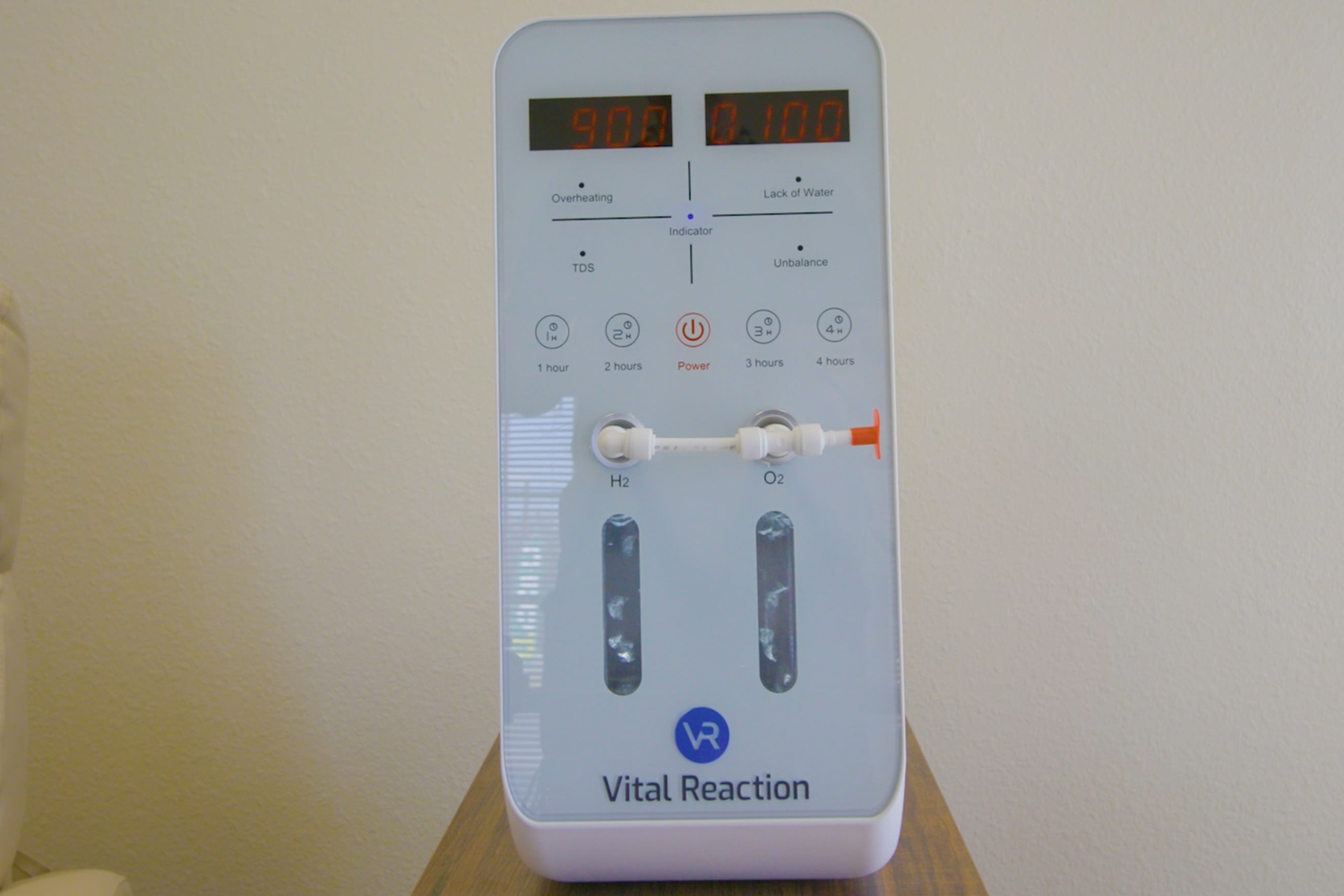
What a session feels like.
Hydrogen inhalation is simple and relaxing. A soft nasal cannula rests at your nose and you breathe normally, with no change in how you breathe required. The mix has no taste or smell, and the machine runs softly in the background.
A session runs about an hour, and most people simply rest through it. A gentle relaxation tends to settle in after a while. The recovery and antioxidant support builds quietly with steady use rather than arriving as a rush. The cannula is light enough that it is easy to forget you are wearing it.
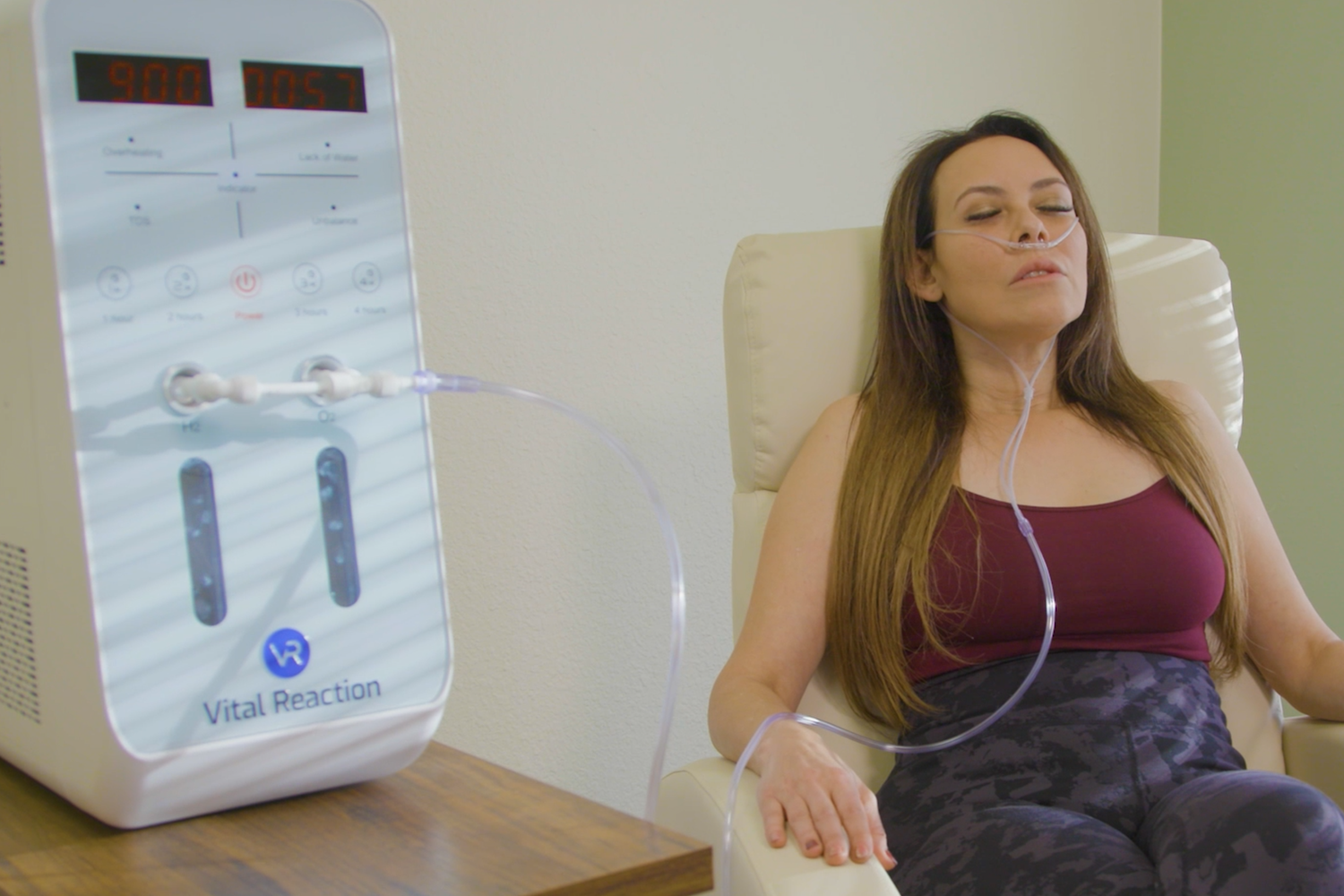
Where this therapy really helps.
What this pairs with.
You can stack it with LED light and grounding to save time.
LED Light
Wear the cannula during an LED facial. Both are calm and completely still, so the two run as one easy session.
Learn more →Grounding
Sit grounded with the cannula in. Two quiet, seated sessions at once, both settling the nervous system.
Learn more →PEMF
A natural companion on the same visit. PEMF works the cellular and nervous-system side while hydrogen eases the oxidative side.
Learn more →Halotherapy
Pair them on a visit built around the breath. A salt-air room and a hydrogen-oxygen session, both centered on easy breathing.
Learn more →What the research shows.
In everyday adults, the clearest human findings are around recovery, fatigue, and a steadier mood. Here is where it stands.
Read the research & sourcesShow less
The interest in molecular hydrogen began with a 2007 laboratory finding that it acts as a selective antioxidant, reacting with the most damaging oxygen radicals while leaving the body's useful ones alone.1 That idea has since grown into well over two thousand publications across cell, animal, and human studies.2
In healthy adults, the clearest human evidence is around exercise and recovery. Meta-analyses of controlled trials find that hydrogen relieves fatigue, helps clear lactate after hard training, and improves lower-body power, while not improving endurance or strength.3 Other trials find it raises the body's antioxidant capacity, though it does not reliably lower oxidative-stress markers themselves.4 The recovery and fatigue side is where the human evidence is strongest.
There is a mental side too. In everyday adults, a controlled trial found that hydrogen-rich water eased stress, anxiety, and mental distress, and calmed the body's stress response.5 On a foggy, worn-down day, that is what it works on: the stress and the fatigue, shown above, that cloud a clear head. It is a steadying, hands-off support for mental freshness, and it does the most for the people who feel that fog the most.
Inflammation is a related thread. In a controlled trial in healthy adults, four weeks of hydrogen-rich water lowered the rate of inflammatory cell death and turned down the body's inflammatory signaling, even as the standard oxidative-stress markers, noted above, held steady.6 That effect showed up in ordinary, healthy people, not only in illness.
Breathing is where the inhaled form has evidence of its own. In a multicenter, double-blind trial in people having a flare of serious, long-term breathing trouble, a hydrogen and oxygen mix eased breathlessness, cough, and congestion more than oxygen alone.7 That research is in people who are unwell rather than in everyday use, so it is not a promise for an everyday session, but it is the reason the oxygen here is paired with hydrogen.
Much of the wider work, the breathing and inflammation studies included, has been done in people managing a health condition rather than in everyday wellness, and the field is still developing. So hydrogen is best understood as an active area of study, not an established treatment. We offer it as antioxidant, recovery, and steadying support that works alongside your care.
Sources
- Ohsawa I, Ishikawa M, Takahashi K, et al. Hydrogen acts as a therapeutic antioxidant by selectively reducing cytotoxic oxygen radicals. Nat Med. 2007;13(6):688–694. Journal
- Johnsen HM, Hiorth M, Klaveness J. Molecular hydrogen therapy: a review on clinical studies and outcomes. Molecules. 2023;28(23):7785. Journal
- Zhou K, Shang Z, Yuan C, et al. Can molecular hydrogen supplementation enhance physical performance in healthy adults? A systematic review and meta-analysis. Front Nutr. 2024;11:1387657. Journal
- Li Y, Bing R, Liu M, et al. Can molecular hydrogen supplementation reduce exercise-induced oxidative stress in healthy adults? A systematic review and meta-analysis. Front Nutr. 2024;11:1328705. Journal
- Mizuno K, Sasaki AT, Ebisu K, et al. Hydrogen-rich water for improvements of mood, anxiety, and autonomic nerve function in daily life. Med Gas Res. 2017;7(4):247–255. Journal
- Sim M, Kim CS, Shon WJ, Lee YK, Choi EY, Shin DM. Hydrogen-rich water reduces inflammatory responses and prevents apoptosis of peripheral blood cells in healthy adults: a randomized, double-blind, controlled trial. Sci Rep. 2020;10(1):12130. Journal
- Zheng ZG, Sun WZ, Hu JY, et al. Hydrogen/oxygen therapy for the treatment of an acute exacerbation of chronic obstructive pulmonary disease: results of a multicenter, randomized, double-blind, parallel-group controlled trial. Respir Res. 2021;22(1):149. Journal
These describe research on molecular hydrogen, not a promise of a result, and hydrogen inhalation is not a treatment for any medical condition. If you are managing a health condition, keep to the care your doctor has set.
This is wellness support, not medical treatment. It supports the body's own processes and works alongside your care, not in place of it.
What people ask.
Is hydrogen inhalation safe?
For most people, yes. It is drug-free and non-invasive, and the hydrogen-oxygen mix is produced at low concentrations and breathed through a simple nasal cannula. Molecular hydrogen has been used in many human studies without serious side effects. If you have a health condition or any concern, we are glad to talk it through at intake.
Is this the same as hydrogen water?
Both deliver molecular hydrogen, just by different routes, one breathed in and the other dissolved in water you drink. We offer the inhaled form here. Neither is a treatment; both are simply ways to take in molecular hydrogen as wellness support.
Will I feel anything?
Usually not much in the moment, and that is normal. This is subtle, cumulative support rather than a strong sensation, and most people just use the time to rest. Any benefit from steady use tends to build quietly over time rather than arrive in a single session.
Do I have to change how I breathe?
No. You breathe normally through a soft nasal cannula. There is nothing to time or control.
Sit back, breathe, and let it work quietly.
Hydrogen-oxygen inhalation is available on all pass tiers, on its own or paired with an LED facial or a grounding session. Antioxidant, recovery, and steadying support you simply breathe in while you rest. It works alongside your care, not in place of it.