A way to work the muscle when effort alone falls short.
Russian Muscle Stimulation uses a controlled electrical current to make a muscle contract on its own, without your effort. It builds strength, and it is especially used to rebuild a muscle left weak by injury, surgery, or a long stretch of pain.
What Russian stim is, and what it's for.
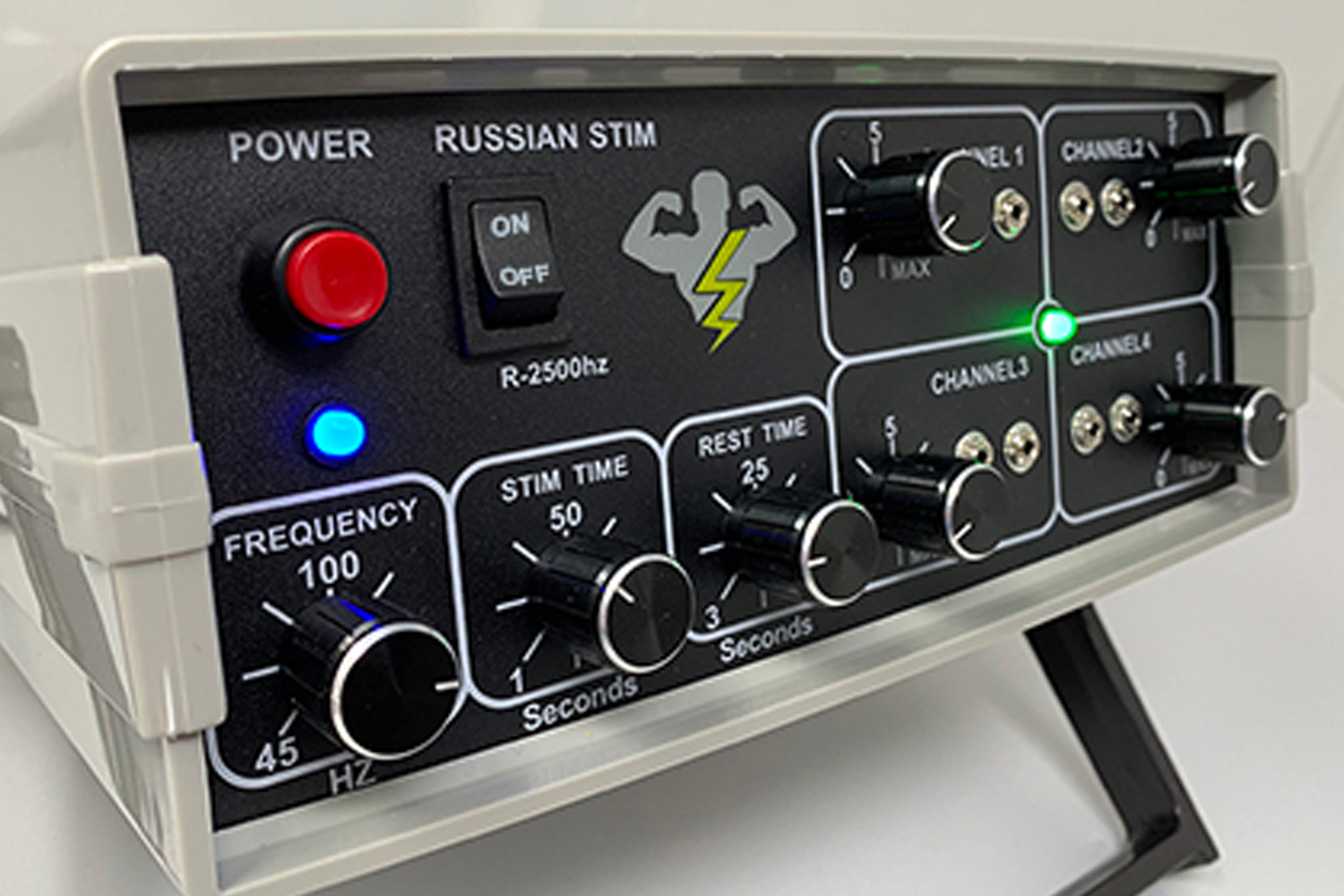
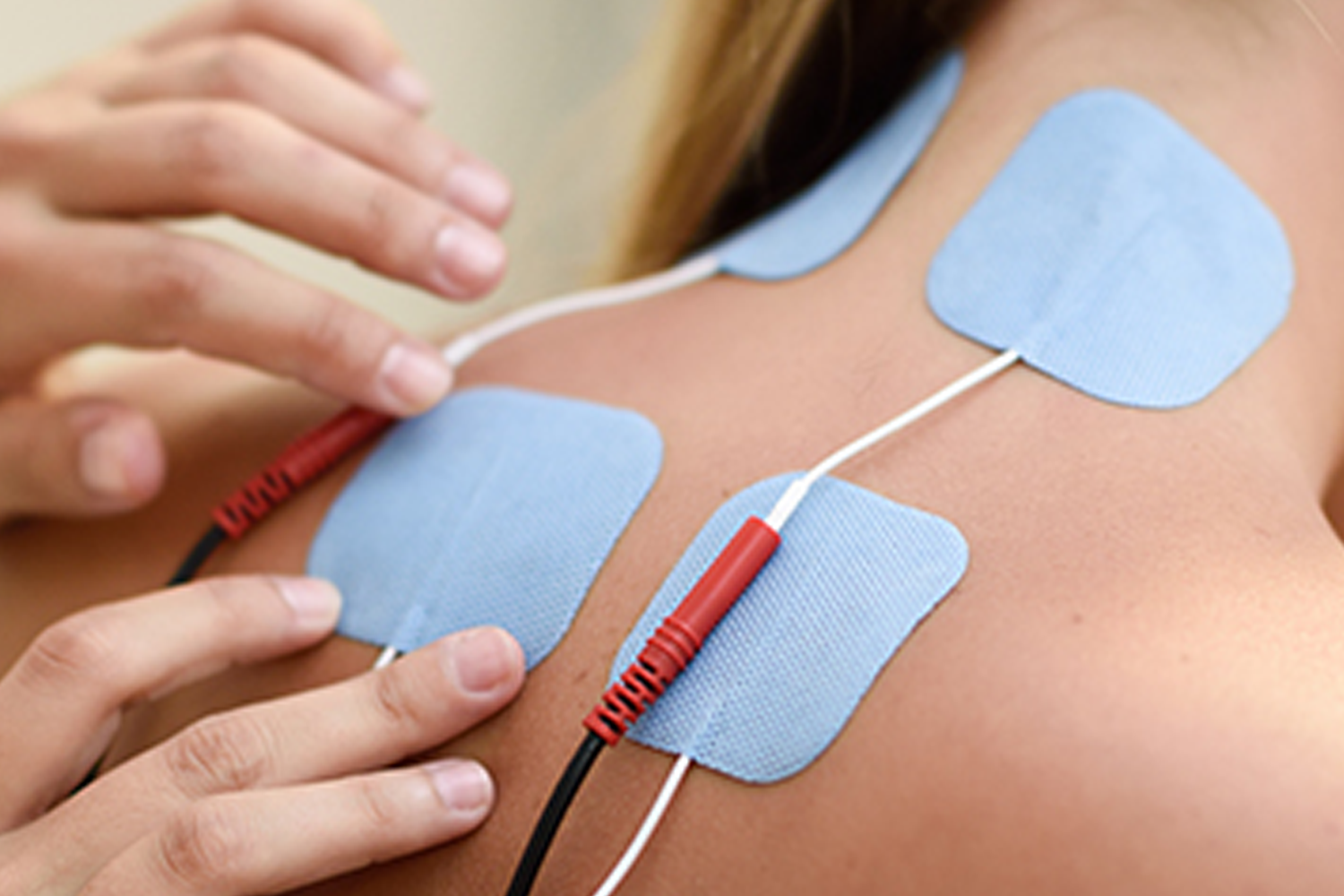
Russian stim sends a controlled electrical current through pads on the skin to make a muscle contract. The current arrives in fast, repeating bursts. Because it does the work rather than your own effort, it can push a muscle hard even when pain or weakness would make that difficult on your own. The approach comes from 1970s Soviet sports science, where athletes used it for strength training.
Its main use is simple: building or rebuilding strength in a muscle that has weakened. That often happens after surgery, an injury, or a long stretch of not moving. By then, ordinary exercise can be hard to do. It can also help retrain muscles that have stopped firing well, though that side is less settled than the strength side. It is a way to load and reawaken a weakened muscle, not a cure for what caused the weakness.
What a session feels like.
Most people feel a strong, rhythmic contraction in the muscle, different than the light tingle of a TENS unit. The muscle visibly tightens and releases in sync with the current. For most first-timers, the sensation takes a moment to get used to, but it settles once the body finds the rhythm.
The intensity is set carefully. It starts low and builds to a strong but comfortable contraction, matched to your response and the muscle being worked. Many people find the contractions oddly satisfying, especially in muscles that have felt tight and stuck for a long time.
Afterward there is usually a brief muscle tiredness, since the muscle has been working hard. It eases within a few hours. People often describe a looser, easier feeling in the area. Over a course of sessions, the aim is steady gains in strength. As with any training, it builds with repetition rather than in a single visit.
Where this therapy really helps.
What this pairs with.
Russian stim works well in a visit that warms the muscles beforehand and supports recovery after.
Mineral Bath
A warm soak beforehand helps loosen tight muscles, which can make the contractions more comfortable to work up to.
Learn more →Contrast Therapy
If a session leaves the muscles sore, the hot-and-cold of contrast therapy is a natural follow-on for recovery.
Learn more →Red Light Therapy
Red light is a quiet session to add afterward, and a common pairing for muscle recovery.
Learn more →PEMF
PEMF is another passive session that sits easily alongside stim in a recovery-focused visit.
Learn more →Zero-Gravity Chair
The zero-gravity chair is a comfortable way to let the body rest after the work of a stim session.
Learn more →BioWaveGo
BioWaveGo takes a different angle on pain, working at the level of the nerve signal, and some people use the two together.
Learn more →What the research shows.
The current reliably builds muscle strength, which is what makes the therapy useful in rehab. The help it can give a stiff joint, a sore back, or sluggish circulation grows out of that same strengthening. The "Russian" part of the name matters less than the stimulation itself.
Read the research & sourcesShow less
The clearest finding is that electrical stimulation can build muscle strength. A review of dozens of controlled trials found it reliably increased quadriceps strength, while noting two real limits: it was less effective than ordinary voluntary exercise, and its effect on muscle size was less certain.1 In other words, it is a useful way to load a muscle, not a replacement for training.
Where it earns its place is rehabilitation, when injury, surgery, or pain makes normal exercise hard. After ACL knee surgery, for example, a systematic review found that adding electrical stimulation helped restore quadriceps strength alongside standard rehab, though the trials were mixed and it is not essential to a good recovery.2 The pattern is consistent: it loads and reawakens a muscle that effort alone is struggling to reach.
The same strengthening can help where a joint has grown stiff and sore. In knee osteoarthritis, the muscle that supports the joint tends to waste and weaken, which makes the knee harder to use. A small study in people with knee osteoarthritis found that a course of stimulation rebuilt some of that lost muscle and, with it, eased joint pain, stiffness, and day-to-day limitation.3 The gain comes from strengthening the support around the joint, not from changing the arthritis itself.
A similar idea applies to the back. Long-standing back pain often goes with weakness in the deep muscles that hold the spine. In a small early trial in older adults with chronic low back pain, stimulating those muscles, on top of trunk exercises, improved everyday function more than a passive comparison.4 The current it used was a medium-frequency type, the same family as the burst current here. The evidence is early and mixed, with some trials finding no added benefit over exercise alone, so it sits alongside movement rather than in place of it.
There is also a circulation effect that comes straight from the contractions. When a muscle tightens, it squeezes the veins running through it and helps push blood back toward the heart, the same pump that working muscles provide during exercise. Measured directly, stimulating the lower-leg muscles clearly raised the speed of blood flowing back up the leg.5 Ordinary movement still moves more blood overall, so this is a nudge for sluggish circulation, not a substitute for being active.
One note about the name. "Russian" stimulation is a specific waveform from 1970s Soviet sports science, and it carries a strong reputation, but the research does not show it is better than other forms of muscle stimulation. In a head-to-head comparison it produced less force than newer waveforms.6 So the benefit comes from the stimulation itself, not from the "Russian" label.
Sources
- Malakoutinia F, et al. Effects of neuromuscular electrical stimulation on quadriceps muscle strength and mass in healthy young and older adults: a scoping review. Physical Therapy. 2021;101(9):pzab144. PubMed
- Kim KM, Croy T, Hertel J, Saliba S. Effects of neuromuscular electrical stimulation after anterior cruciate ligament reconstruction on quadriceps strength, function, and patient-oriented outcomes: a systematic review. Journal of Orthopaedic & Sports Physical Therapy. 2010;40(7):383–391. PubMed
- Vaz MA, Baroni BM, Geremia JM, Lanferdini FJ, Mayer A, Arampatzis A, Herzog W. Neuromuscular electrical stimulation (NMES) reduces structural and functional losses of quadriceps muscle and improves health status in patients with knee osteoarthritis. Journal of Orthopaedic Research. 2013;31(4):511–516. DOI
- Hicks GE, Sions JM, Velasco TO, Manal TJ. Trunk muscle training augmented with neuromuscular electrical stimulation appears to improve function in older adults with chronic low back pain: a randomized preliminary trial. Clinical Journal of Pain. 2016;32(10):898–906. PubMed
- Avazzadeh S, O'Farrell A, Flaherty K, O'Connell S, ÓLaighin G, Quinlan LR. Comparison of the hemodynamic performance of two neuromuscular electrical stimulation devices applied to the lower limb. Journal of Personalized Medicine. 2020;10(2):36. DOI
- Dantas LO, et al. Comparison between the effects of 4 different electrical stimulation current waveforms on isometric knee extension torque and perceived discomfort in healthy women. Muscle & Nerve. 2015;51(1):76–82. PubMed
These studies describe the therapy in general, not this specific device, and none of them is a promise of a result. The strongest evidence is for strength and rehabilitation, not for the broader claims sometimes made about this modality.
This is wellness support, not medical treatment. It supports the body's own processes and works alongside your care, not in place of it.
What people ask.
Is it painful?
It is intense but shouldn't be painful when properly calibrated. The strong contractions can feel unfamiliar and demanding, especially for muscles that aren't used to working that hard. We begin below the comfortable threshold and adjust throughout, and you can have it turned down at any point.
Is there anyone who shouldn't use it?
Yes. It isn't used for anyone with a pacemaker, defibrillator, or other implanted electronic device. The current can interfere with them. It also isn't used during pregnancy, or directly over an area of active cancer. Tell us about any of these, or any recent surgery, at intake, and we'll confirm what's appropriate.
How is this different from a TENS unit?
A TENS unit uses a low-level current to create a tingle that helps mask pain; it doesn't produce real muscle contractions. Russian stim uses a much stronger, burst-patterned current to make the muscle contract and work. The two do quite different things, one for pain, one for the muscle itself.
Is it safe after orthopedic surgery?
It is widely used in rehab after orthopedic surgery, including joint replacements and ligament repairs. When to begin depends on the procedure and your surgeon's clearance. We ask about recent surgeries and set the protocol to respect your healing timeline. We won't work an area your surgeon hasn't cleared.
How many sessions before I notice anything?
Like any kind of strength work, it builds with repetition rather than in a single visit. Some people feel looser and a little stronger early on. Rebuilding real strength in a weakened muscle usually takes a course of regular sessions.
A way to help a weakened muscle get back to work.
Russian stim is available on the Transform pass and above, and as a standalone session for rehab, strength, or athletic recovery. It works alongside your care, not in place of it.