Sore muscles, aching joints, skin that's lost its glow?
Lie back in deep red and near-infrared light for twenty quiet minutes. There's no heat to brace against and nothing you have to do, while the light works on skin, muscle, and joints at once.
What the light does, and where it reaches.
Our panel projects a wide band of light, from 480 to 1060 nanometers, with the red and near-infrared wavelengths doing the work here. Your cells absorb it, mostly the part of each cell that makes energy. The leading explanation is that the light helps those cells make energy a little more efficiently, which over a course of sessions supports repair and eases inflammation. Near-infrared reaches deeper than red light does, so the effects are not limited to the skin.
It is a high-output system. You lie on a large massage table beneath it, and it reaches a wide area of the body at once. People use it for recovery after training, for nagging joint and muscle aches, for skin, complexion, tone, and the slow work of collagen, and in the evening to wind down toward sleep. For a targeted skin or facial concern, the LED therapy room is the better fit; this is the full-body option.
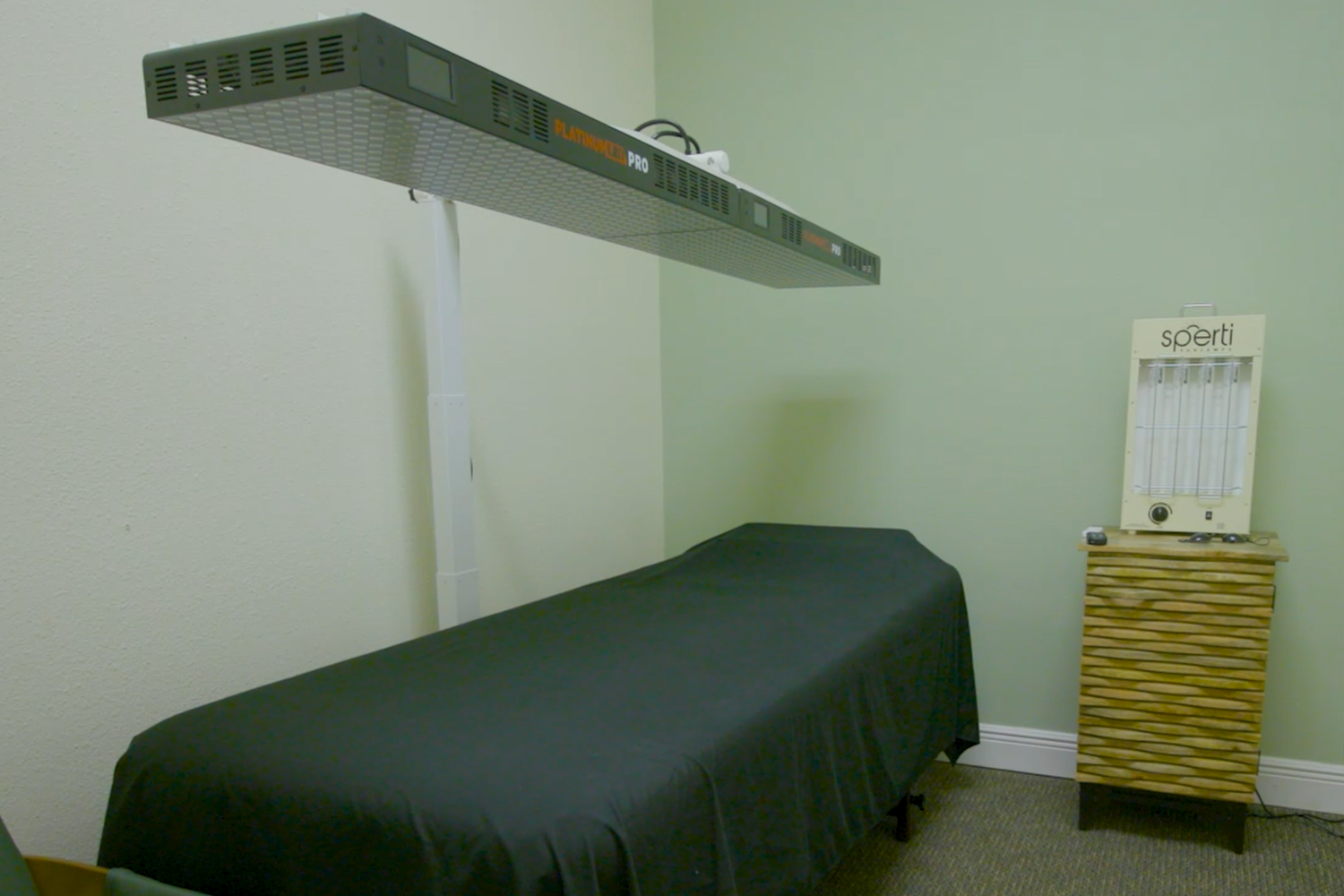
What a session feels like.
Red light is one of the quieter sessions here. You lie back on the table, and there is no real heat, just a gentle warmth that builds slowly, like standing in early sun. The light is deep red and bright, so you keep your eyes closed or wear the shades we provide.
There is nothing to do. Many people use the time to rest, breathe, or let the mind wander. A session runs twenty minutes, and the effect does not depend on effort, you only have to be in the light.
Afterward most people feel calm and a little loosened, rather than wired or energized, which is part of why an evening session can help you wind down toward sleep. The visible changes, in skin and in how sore muscles feel, build over a run of sessions rather than after a single one.
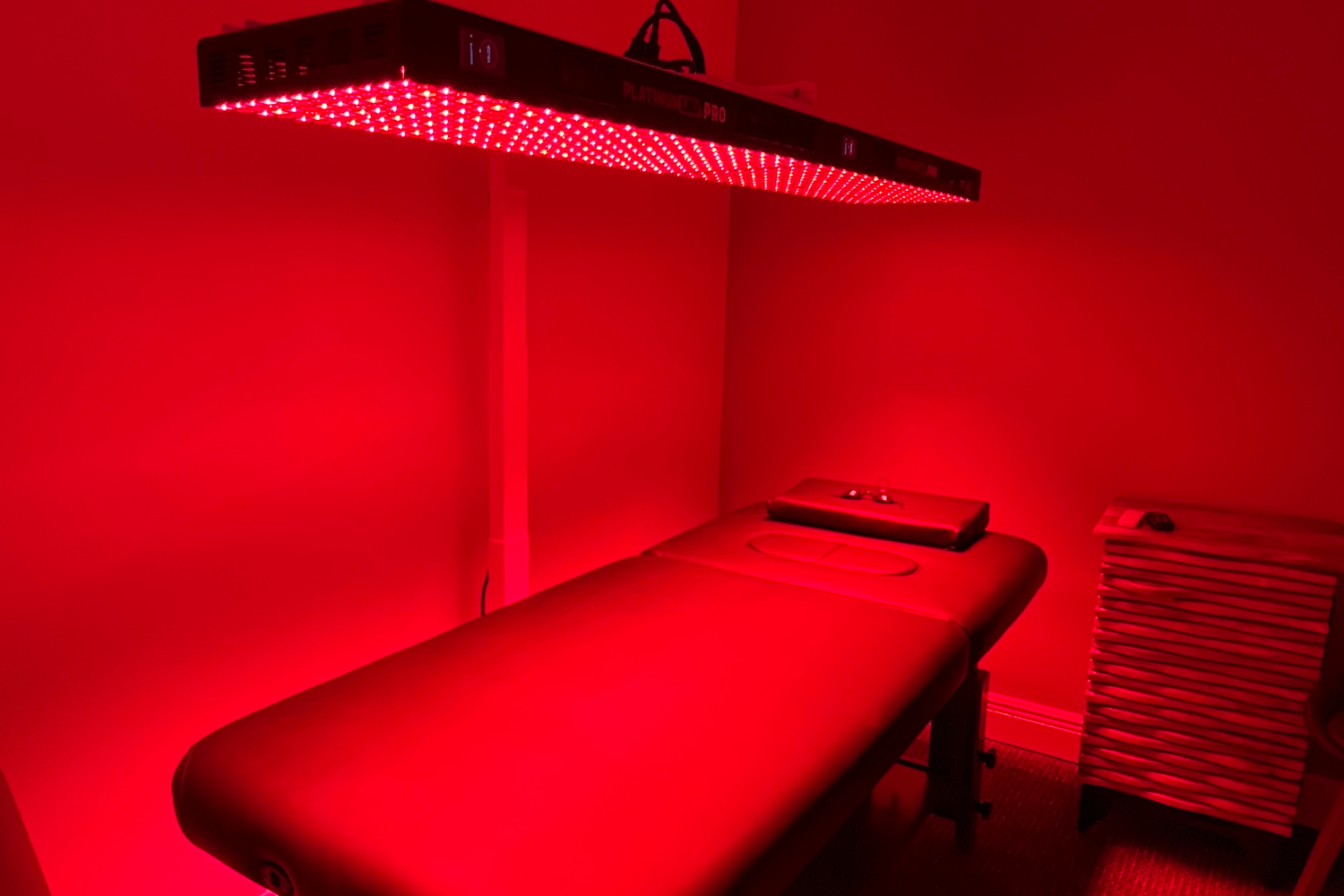
Where this therapy really helps.
What this pairs with.
Red light is calm and passive, so it sits easily alongside the more active sessions.
PEMF
PEMF is another quiet, passive session, and the two are easy to stack on a recovery day.
Learn more →Full-Spectrum Sauna
Warm through in the sauna, then rest under the light, an easy pairing for an unwinding visit.
Learn more →Contrast Therapy
Contrast gets the circulation moving; red light is a calm way to round out a recovery session.
Learn more →Russian Muscle Stim
Russian stim works the muscle directly, and red light is a gentle session to pair with it.
Learn more →What the research shows.
Red light's clearest effects are on the skin and on muscle recovery: more collagen, faster bounce-back after hard efforts. Support for joint pain and sleep is growing. Here is where each one stands.
Read the research & sourcesShow less
The most rigorous skin study is a randomized controlled trial of red and near-infrared light. Over 30 sessions, people saw measurable improvements in skin complexion and roughness, and ultrasound confirmed an increase in collagen density.1 That is a structural change, not just a temporary glow.
For muscle, a meta-analysis of controlled trials found that red and near-infrared light, used around exercise, improved muscle performance and reduced markers of fatigue and damage afterward.2 It is part of why athletes use it to recover.
For joints, a 2024 meta-analysis in older adults found that this kind of light improved knee function and pain.3 The picture for pain and inflammation is encouraging, and still building.
There is also early support for sleep. In a small controlled study, athletes who spent 30 minutes under a whole-body red light each night for two weeks slept better, and had higher morning melatonin, than a group who did not, with the two changes tracking together.4 Red light, unlike the blue light from screens, does not appear to suppress melatonin, which is the likely reason. This evidence is small and early, but it fits the calm most people feel after a session.
Red light is studied for still other uses, from mood to bone, but that evidence is thinner again. Dose also matters: these effects come from enough light over a full session, the kind our clinical panel is built to deliver. Its light output is independently tested by an outside lab, and it is built to medical electrical-safety standards.
Sources
- Wunsch A, Matuschka K. A controlled trial to determine the efficacy of red and near-infrared light treatment in patient satisfaction, reduction of fine lines, wrinkles, skin roughness, and intradermal collagen density increase. Photomed Laser Surg. 2014;32(2):93–100. PubMed
- Leal-Junior ECP, Vanin AA, Miranda EF, et al. Effect of phototherapy (low-level laser therapy and light-emitting diode therapy) on exercise performance and markers of exercise recovery: a systematic review with meta-analysis. Lasers Med Sci. 2015;30(2):925–939. PubMed
- Li BM, Zhang CK, He JH, et al. The effects of photobiomodulation on knee function, pain, and exercise tolerance in older adults: a meta-analysis of randomized controlled trials. Arch Phys Med Rehabil. 2024;105(3):593–603. Journal
- Zhao J, Tian Y, Nie J, Xu J, Liu D. Red light and the sleep quality and endurance performance of Chinese female basketball players. J Athl Train. 2012;47(6):673–678. PubMed
These studies describe red and near-infrared light in general, not this specific panel, and none is a promise of a result. The clearest support is for skin, muscle recovery, and joint pain; the sleep evidence is earlier and smaller.
This is wellness support, not medical treatment. It supports the body's own processes and works alongside your care, not in place of it.
What people ask.
Is red light safe, and does it suit all skin types?
Yes, and it suits all skin tones. At these wavelengths it is gentle and does not cause the kind of damage UV light does. A few things to flag at intake: if you take a medication that raises light sensitivity (some antibiotics, acne, or psychiatric medications), or if you are pregnant, tell us so we can adjust, and we keep the light off any area of active skin cancer. You will close your eyes or wear shades during the session.
Is this the same as the LED light therapy?
They overlap, but they are set up for different jobs. This is a full-body red and near-infrared panel, aimed at recovery, muscle and joint aches, and overall skin. The LED room uses a range of colors up close for targeted skin and facial concerns. If your goal is whole-body recovery, this is the one; for a specific skin or facial issue, the LED therapy is the better fit.
How many sessions before I notice?
It builds rather than switches on. Skin changes, complexion and texture, tend to show over several weeks of regular sessions. Recovery and how sore muscles feel can be noticeable sooner. Steady, repeated sessions matter more than any single one.
Can I use it every day?
Yes. It is gentle enough for frequent use, and regular sessions are where the benefit comes from. Many people fold it in a few times a week.
Rest in the light. The work happens on its own.
Red light therapy is available on all pass tiers, on its own or stacked with the more active sessions. A calm, hands-off way to support recovery, ease aches, care for your skin, and help you wind down toward sleep. It works alongside your care, not in place of it.