The deepest rest in years may happen here.
Full-spectrum infrared heat warms the body from within. Chromotherapy bathes the room in calming color. And therapeutic sound, felt as much as heard, settles the nervous system toward rest. Three layers in one room, reaching what plain rest can't.
Three therapies in one room, and why they belong together.
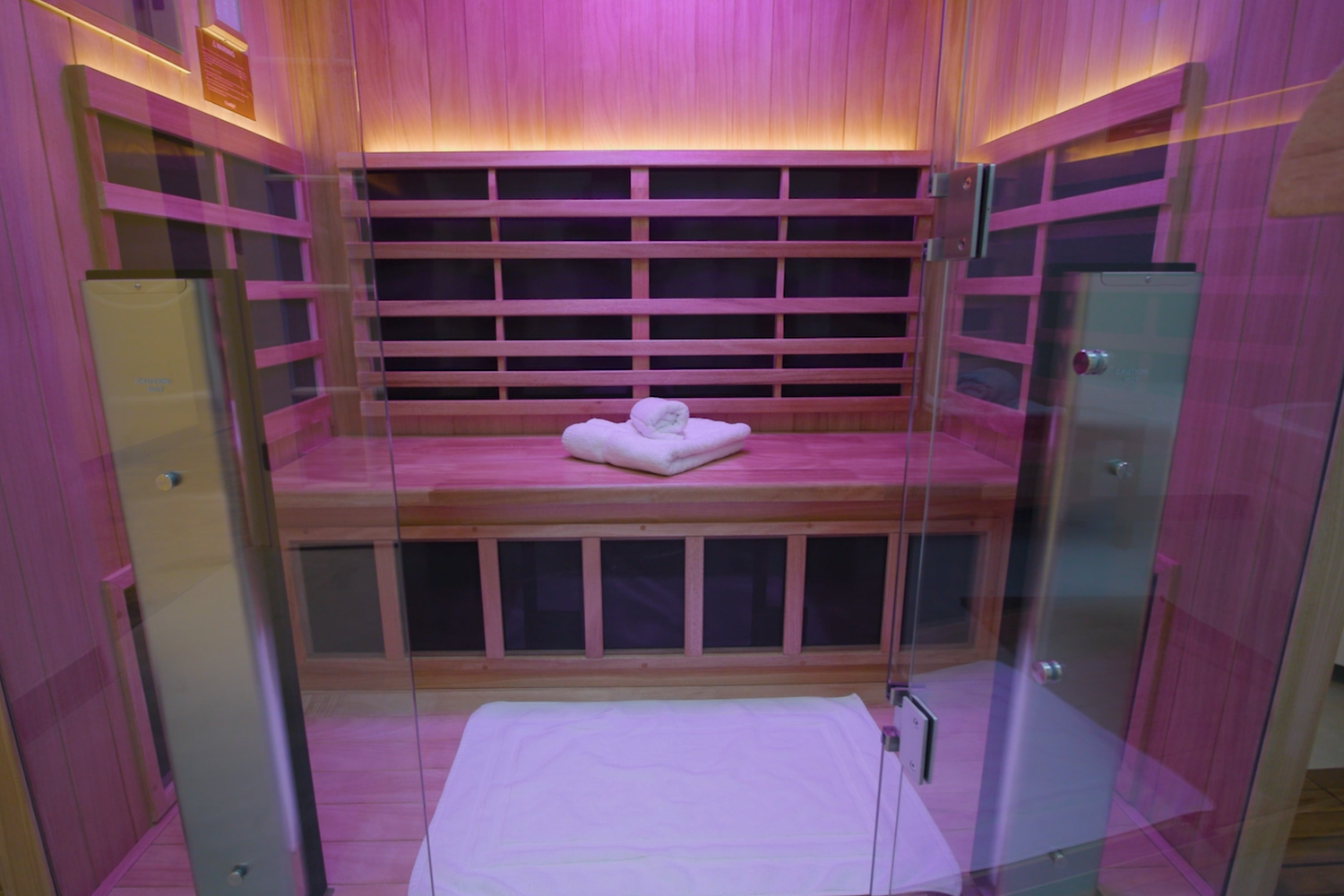
Our infrared sauna uses full-spectrum infrared, near, mid, and far, to warm the body directly instead of heating the air around you. That is the real difference from a regular dry sauna. It lets the room stay at a comfortable temperature while still drawing a deep sweat. The warmth opens the blood vessels and lifts the heart rate in a way that has been likened to light exercise. And the body settles, the way it does under any steady, comfortable heat.
Chromotherapy adds the color-light layer. The cabin lights through a spectrum of soft colors, each with a long history in color-healing traditions. Its effect is gentler than the heat's, a way to set the mood of the session, warming and energizing or cooling and calming. Many people find it deepens the relaxation.
The VibroAcoustic side adds therapeutic sound. Specific frequencies travel through the structure of the sauna, so the body takes them in not only as sound but as physical vibration. That gentle vibration is meant to settle the nervous system into the calm, recovery state that chronic stress tends to keep switched off.
What a session feels like.
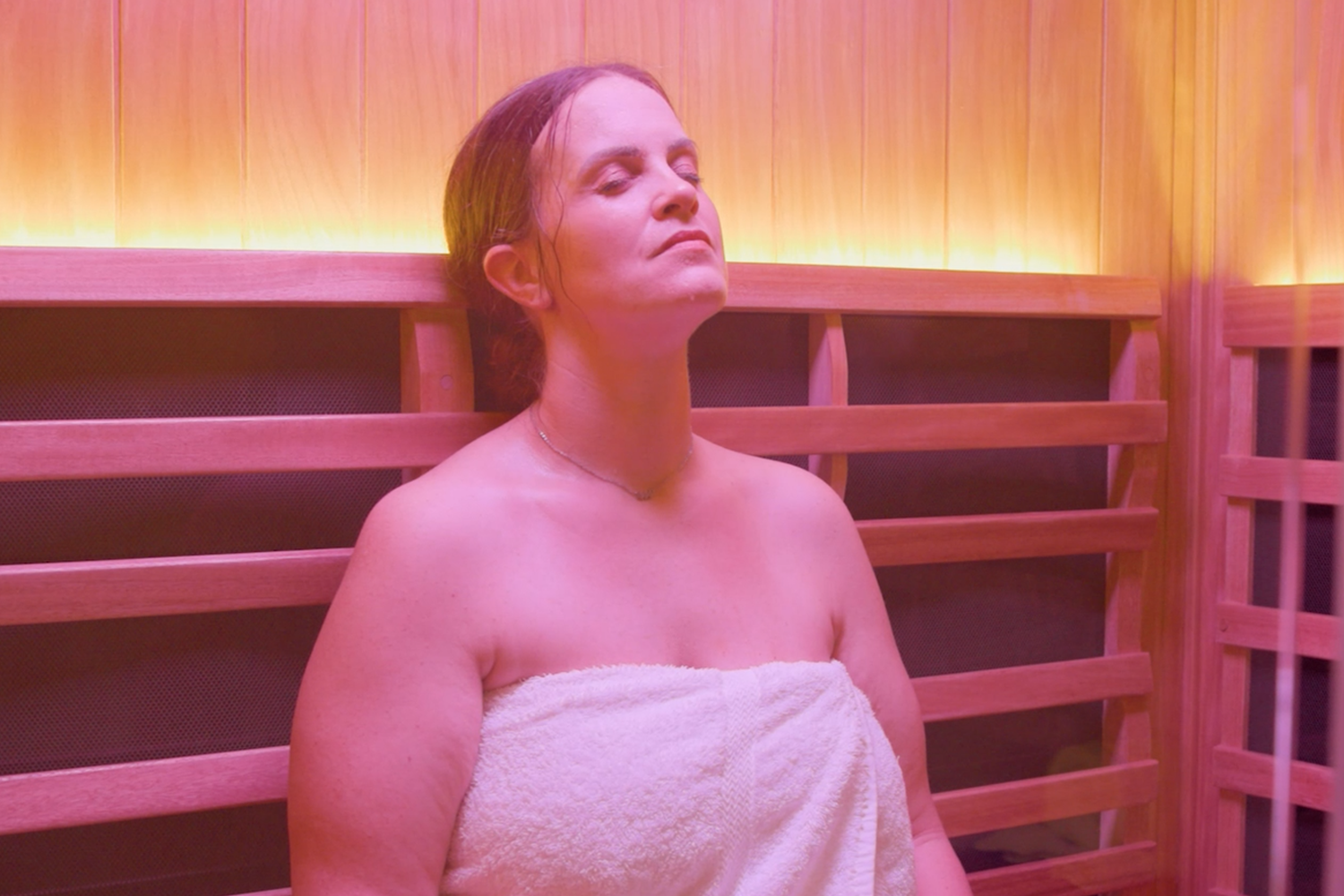
You step in to a warmth that arrives differently than a regular sauna. It reaches deeper than the surface, into the muscles of the back and shoulders, within the first five minutes. The tight, hot air of a traditional sauna doesn't do that. The room glows with the color you've chosen. The sound begins with the session too, a gentle vibration through the bench that the body registers as sound felt rather than heard.
By ten minutes, most people notice that particular ease the heat brings. The jaw releases, the shoulders drop, and the low-grade tension that became so normal it stopped registering starts to soften. By twenty minutes, the sweat is real, and so is the depth of the rest. For many people that downshift feels almost unfamiliar, because real rest has become unfamiliar.
The window afterward is one we design around. People move from the sauna into quiet rest or another therapy while that settled state is still there. Most notice the clarity of a system that has truly let go, and warmth in the hands and feet from better circulation.
Where this therapy really helps.
What this pairs with.
The sauna produces the open, receptive state in which other therapies work best, which makes it a natural first or last session in any visit.
Cold Plunge
Sauna then cold plunge is the natural next step: the heat opens the vessels, the cold tightens them, and the alternation does what heat alone can't. Done as a guided protocol in the same room, that pairing is our contrast therapy.
Learn more →PEMF
PEMF after the sauna adds another layer of relaxation through gentle magnetic pulses.
Learn more →Grounding
Grounding after the sauna extends the settled, restful state as the body cools.
Learn more →Integral Sound Healing
A sound healing session after the sauna starts from a deeper baseline, the nervous system already downshifted and more receptive.
Learn more →Halotherapy
The salt room after the sauna continues the respiratory calm as the body cools, an easy pair in a single visit.
Learn more →What the research shows.
Infrared sauna's clearest support is for circulation and the deep rest people feel, with mood, sleep, and chronic pain more encouraging than settled. The studies are still smaller and earlier than the research on traditional saunas. Here is what they say, and where the limits are.
Read the research & sourcesShow less
A review in Canadian Family Physician gathered the human studies on far-infrared sauna and found support for its place alongside care for heart and circulatory health, while saying plainly that the published evidence is still limited.1 Reviewing the same field, Mayo Clinic puts it carefully: the studies suggest sauna may help with several conditions, and larger, more exact trials are still needed.2
For chronic pain, a study of repeated whole-body thermal therapy reported better outcomes for the people who received it, and the authors called it a promising approach.3 The part most people feel first, the rest itself, sits well within the evidence too: the warmth lifts the heart rate and opens the blood vessels in a way that has been likened to a moderate walk, and the body settles toward the calm state that steady, comfortable heat tends to bring.4
One of those infrared studies looked straight at the blood vessels. In men with cardiovascular risk factors, two weeks of daily far-infrared sauna improved how well their vessels opened to let blood through, a standard measure of vascular health called flow-mediated dilation.5 It is a small study, as most in this field are, so it points the right way rather than settling the matter. But it fits what the heat is doing: warming the body opens the vessels and gets the blood moving, the basis of healthy circulation and a real part of cardiovascular wellness.
The longest-running sauna research comes from Finland, where following regular users across decades links frequent sauna bathing with lower cardiovascular and all-cause mortality.6 That work studied traditional hot saunas rather than infrared, so it is the broader backdrop for why heat, and the body's response to it, matters, not a claim about this room.
Heat and mood is the newer thread, and the most striking. In a sham-controlled trial, a single session of whole-body heating produced a meaningful drop in depression scores that held for weeks.7 That trial used a medical heating device rather than a sauna, so it speaks more to the mechanism, raising the body's core temperature, than to this exact room. Among regular sauna users, a large survey points the same way. Most reported better sleep for a night or two after a session, and the most frequent bathers scored higher on mental wellbeing.8 That part is self-reported rather than a controlled trial, so it is encouraging rather than settled. It speaks to the experience, a lift in low mood and steadier sleep, not to treating depression.
On inflammation, the signal is real but indirect. In a long-running study of more than two thousand men, those who used a sauna more often had lower levels of C-reactive protein, a standard blood marker of inflammation, and the pattern followed the dose: the more sessions per week, the lower the level.9 This is observational and from traditional saunas, so it shows an association rather than proof. It lines up with what the heat does: opening the vessels, moving the blood, and prompting the body's own heat-adaptation response.
The VibroAcoustic layer is an early area of study for nervous-system regulation. Chromotherapy's evidence is softer still, more about mood and atmosphere. It is a calming layer, not a cellular treatment.
Sources
- Beever R. Far-infrared saunas for treatment of cardiovascular risk factors: summary of published evidence. Canadian Family Physician. 2009;55(7):691–696. PubMed
- Mayo Clinic. Do infrared saunas have any health benefits? 2024. mayoclinic.org
- Masuda A, Koga Y, Hattanmaru M, Minagoe S, Tei C. The effects of repeated thermal therapy for patients with chronic pain. Psychotherapy and Psychosomatics. 2005;74(5):288–294. PubMed
- Cleveland Clinic. Infrared saunas: what they do and 6 health benefits. 2022. clevelandclinic.org
- Imamura M, Biro S, Kihara T, et al. Repeated thermal therapy improves impaired vascular endothelial function in patients with coronary risk factors. Journal of the American College of Cardiology. 2001;38(4):1083–1088. PubMed
- Laukkanen T, Khan H, Zaccardi F, Laukkanen JA. Association between sauna bathing and fatal cardiovascular and all-cause mortality events. JAMA Internal Medicine. 2015;175(4):542–548. PubMed (traditional Finnish sauna)
- Janssen CW, Lowry CA, Mehl MR, et al. Whole-body hyperthermia for the treatment of major depressive disorder: a randomized clinical trial. JAMA Psychiatry. 2016;73(8):789–795. PubMed (medical whole-body heating device, not a sauna)
- Hussain JN, Greaves RF, Cohen MM. A hot topic for health: results of the Global Sauna Survey. Complementary Therapies in Medicine. 2019;44:223–234. PubMed (survey of regular sauna users)
- Kunutsor SK, Laukkanen T, Laukkanen JA. Longitudinal associations of sauna bathing with inflammation and oxidative stress: the KIHD prospective cohort study. Annals of Medicine. 2018;50(5):437–442. PubMed (traditional Finnish sauna)
None of these studies is a promise of a result.
This is wellness support, not medical treatment. It supports the body's own processes and works alongside your care, not in place of it.
What people ask.
Is full-spectrum infrared different from a regular sauna?
Yes, meaningfully. A conventional sauna heats the air to 180 to 200°F and warms you mostly through hot air. Full-spectrum infrared warms the body directly at a more comfortable 120 to 140°F, still producing a deep sweat. The way the heat reaches you is different, which is why the lower temperature can feel just as effective.
What is chromotherapy, and does it do the same thing as red light?
No, they're different. Chromotherapy is the soft colored light in the cabin, drawn from color-healing traditions. It sets the mood of the session, calming or energizing. Red light therapy is a separate service that uses specific red and near-infrared light for effects at the cell level. So the sauna's color is the mood-setting layer. For the cellular work, see the red light page.
Is the sauna good for circulation and cardiovascular health?
It's one of the better reasons to use it. Warming the body opens the blood vessels and lifts the heart rate in a way that has been compared to a brisk walk. And in studies, far-infrared sauna improved how well the blood vessels of men with cardiac risk factors opened to move blood. That makes it a calm, passive way to support circulation and blood flow, the systems that sit underneath energy and recovery. As with everything here, it works alongside your care, not in place of it.
Can I use it if I'm pregnant or have a medical condition?
Pregnancy, an active fever, and certain heart and autoimmune conditions call for caution or medical clearance first. Our intake captures the relevant health information and we talk through anything that might affect the protocol before a first session.
How often should I use it?
Two to three sessions a week tends to give the most steady benefit for the heart and the nervous system. Daily use is safe for most people. The mood and pain benefits build with use, so steady visits do more than the occasional one.
The nervous system already knows how to rest. It needs the right conditions.
The infrared sauna is available on all pass tiers. It is the therapy most people return to most often, and the one that changes the quality of everything else.