Flat, foggy, dragging by mid-afternoon?
A few rounds between deep heat and cold water gets the blood moving and the head clear. Most people walk out sharper and more awake than when they came in, and it holds for hours.
What the hot-and-cold cycle does.
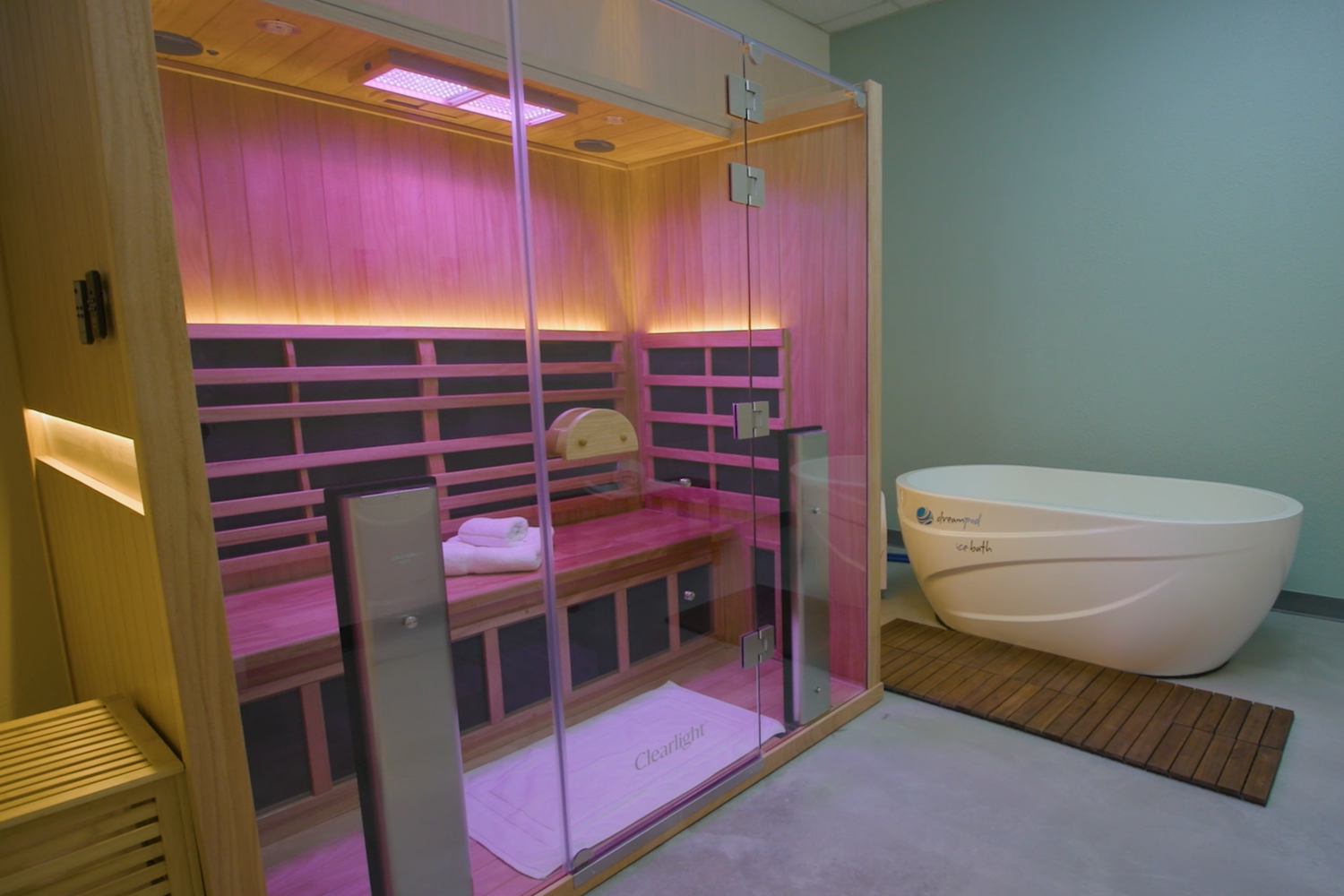
Contrast therapy is a structured back-and-forth between hot and cold: a few minutes in the infrared sauna, then a short cold plunge, repeated for a few rounds. The therapy is the cycling, not either temperature on its own. Heat widens the blood vessels and cold narrows them, so going back and forth moves blood around the body.
People use it most for recovery after hard exercise, and also for circulation and a lift in mood and energy. If you would rather have just the heat or just the cold, each is its own session here. Contrast is for when you want the full back-and-forth as one set sequence.
What a session feels like.
You start in the warmth, usually five to ten minutes in the sauna, long enough to warm through and feel the tension start to let go.
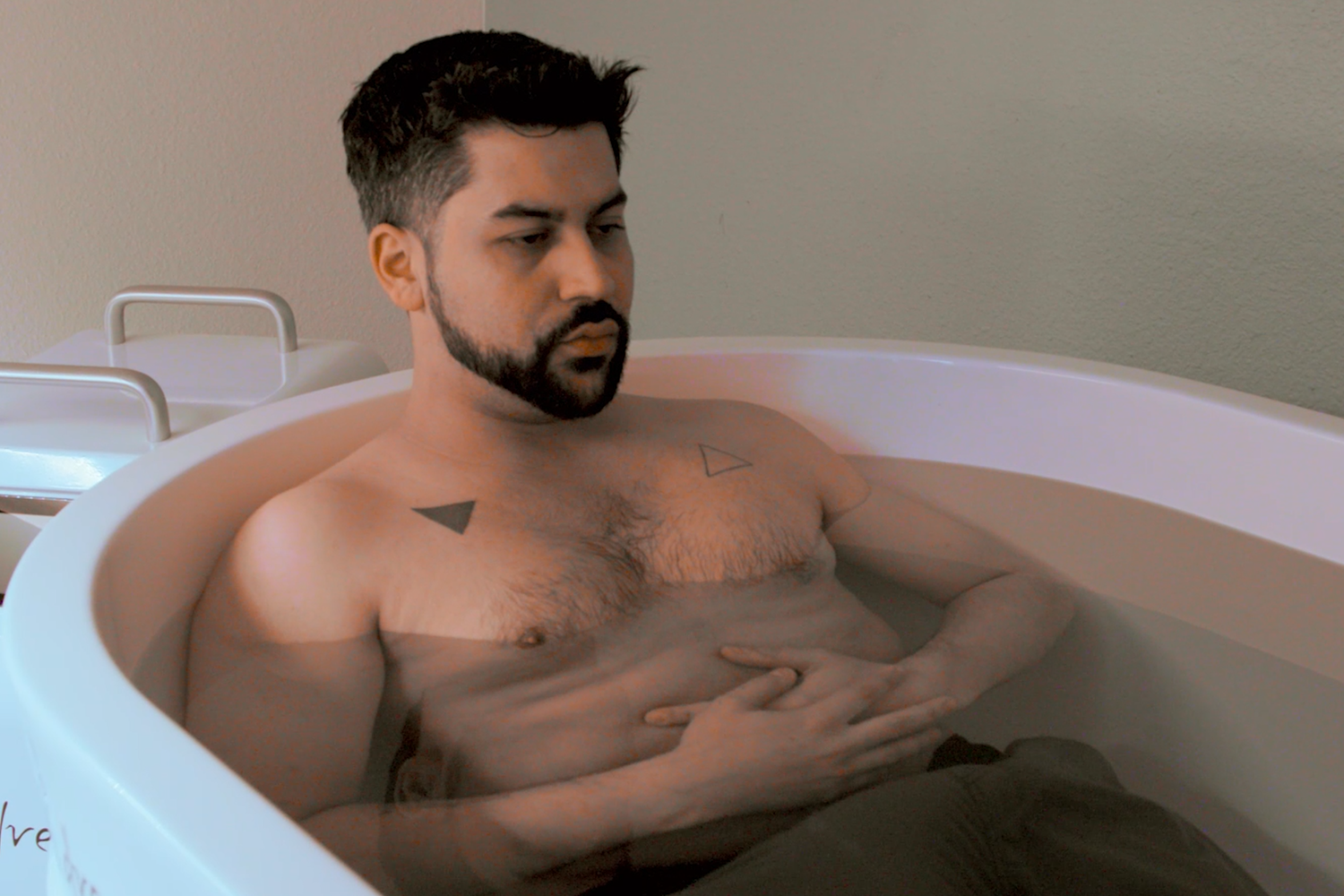
The cold comes next, bracing and clarifying. The first breath is sharp, and settling in from there is where the resilience grows. Around the twenty- to thirty-second mark for most people, it opens into a clear, alert focus.
Then back to the warmth, and around again, usually two to three rounds. By the end, most people notice warmth in the hands and feet, a lightness in the limbs, and an alertness that tends to carry for a while afterward.
Where this therapy really helps.
What this pairs with.
Contrast is built from two sessions you can also use on their own, and it pairs easily with these recovery and relaxation therapies.
Red Light Therapy
Red light is a calm, passive session to add on a recovery day, a common pairing after the work of contrast.
Learn more →PEMF
PEMF is another quiet, passive session that sits easily alongside contrast in a recovery-focused visit.
Learn more →Russian Muscle Stim
Russian stim works weakened or recovering muscles directly, and contrast is an easy recovery session to pair with it on the same visit.
Learn more →Zero-Gravity Chair
The zero-gravity massage chair is a comfortable, passive way to rest after the back-and-forth of contrast, a calm finish to a recovery visit.
Learn more →Grounding
Grounding is a calm way to settle after contrast fires the system up, an easy way to come back down before you leave.
Learn more →What the research shows.
Contrast's clearest effect is on recovery: it eases the muscle soreness and strength loss after hard exercise. The circulation effect is real in the moment but not proven to last. Here is where each stands.
Read the research & sourcesShow less
The clearest evidence is for recovery. A review that pooled the trials found that contrast eases muscle soreness and strength loss after hard exercise better than simply resting.1 Two limits come from the same review: it was not clearly better than other recovery methods like cold water alone or compression, and the studies were low in quality. So it is a solid recovery option, not a magic one.
Each half also brings its own support. On the warm side, far-infrared sauna has been shown to improve blood-vessel function in men with cardiac risk factors.2 On the cold side, a brief cold dip drives up noradrenaline, the chemical behind the alert, clear-headed lift.3 One caution on that last point: the dramatic numbers often quoted come from a long, hour-long cold exposure, far more than a short plunge, so a few cold seconds will not match them.
The appeal of contrast is the idea of a workout for the blood vessels: warmth opens them, cold tightens them, and the back-and-forth gets blood moving. That moment-to-moment effect is real, and it is part of why contrast feels so invigorating. Whether the cycling lastingly trains the vessels is more a reasonable idea than a settled fact.
Sources
- Bieuzen F, Bleakley CM, Costello JT. Contrast water therapy and exercise induced muscle damage: a systematic review and meta-analysis. PLoS ONE. 2013;8(4):e62356. PubMed
- Imamura M, Biro S, Kihara T, et al. Repeated thermal therapy improves impaired vascular endothelial function in patients with coronary risk factors. Journal of the American College of Cardiology. 2001;38(4):1083–1088. PubMed
- Šrámek P, Šimečková M, Janský L, Šavlíková J, Vybíral S. Human physiological responses to immersion into water of different temperatures. European Journal of Applied Physiology. 2000;81(5):436–442. Journal
These studies describe the therapies in general, not this specific setup, and none of them is a promise of a result. The strongest support is for recovery; the lasting circulation benefits are a reasonable idea rather than a settled one.
This is wellness support, not medical treatment. It supports the body's own processes and works alongside your care, not in place of it.
What people ask.
Is contrast just doing the sauna and cold plunge back to back?
In essence, yes, but the sequence is the point. Contrast is a structured protocol: set times in the heat, set times in the cold, a set number of rounds, paced to your experience. That structure is what gives the back-and-forth its effect, which is why it is its own session rather than two separate ones.
What if it's my first time?
If you'd like, someone will walk you through the whole thing on a first visit, how long in the heat, how long in the cold, how many rounds, all paced with you. It's there whenever you want it, and easy to skip if you'd rather just get in.
Can I do just the heat or just the cold instead?
Yes. The infrared sauna and the cold plunge are each their own session here, with their own pages. Contrast is for when you want the full hot-cold back-and-forth as one set sequence. If you want a single temperature, start there.
Is it safe with a heart condition or in pregnancy?
Contrast is a real stimulus for the heart and blood vessels, and it includes deep heat, so some situations call for medical clearance first: uncontrolled high blood pressure, recent cardiac events, Raynaud's in an acute phase, and pregnancy. Our intake captures your history and we set the protocol accordingly, and we never push past what's comfortable.
How often should I do it?
For recovery and general circulation, two to three sessions a week tends to give the most consistent benefit. The effect builds with steady use, so consistency over weeks does more than a few intense sessions.
Warm, loose, and wide awake by the end.
Contrast is available on all pass tiers, on its own or built from the sauna and cold plunge you can also use separately. Start short and build at your own pace. It works alongside your care, not in place of it.